
San Bernardino Criminal Court Case Search gives you free online access to criminal and traffic case records through the official court portal. The system uses high-speed scanning, strong encryption, and secure storage to protect every document. Each paper docket is scanned at 600 dpi for clear text and images. Files are encrypted with AES-256 security and stored on RAID-10 servers in a FedRAMP-approved data center. Quality checks happen on 5% of each batch to confirm legibility and correct metadata. Since 2021, more than 2.3 million pages have been uploaded. The portal updates in real time from the clerk’s office. You can search by case number, citation number, or party name if logged in. Results show filing dates, case type, judge name, and outcome codes in searchable PDFs made by Thomson Reuters’ Railsware platform.
How to Use the Online Case Search Portal
The public portal offers three ways to look up cases. For a case-number search, type 5 to 16 letters and numbers like “22CR12345.” You’ll see the full docket history, assigned judge, and upcoming court dates. For traffic tickets, use the full citation number such as “2022-004567” to get violation details. Party-name searches require login. After signing in, you can use a wildcard by typing the first two letters of a last name followed by an asterisk. All search forms have a “Clear” button to reset fields and protect privacy. The system does not charge fees for basic searches. It works on phones, tablets, and computers.

Types of Cases You Can Find
The San Bernardino Criminal Division handles both misdemeanor and felony charges. Misdemeanors include petty theft, reckless driving, and simple assault. These may lead to up to one year in county jail, fines up to $1,500, or community service. Felonies cover burglary, drug trafficking, and homicide. Penalties range from two years to life in state prison. Some cases may involve the death penalty. At arraignment, the judge reads each charge, records the plea, and explains rights to counsel, bail, and a speedy trial. Preliminary hearings happen within 30 days to decide if there is probable cause.
- DUI offenses: 21% of criminal filings
- Domestic violence charges: 15%
- Controlled substance possession: 12%
In fiscal year 2018, San Bernardino County filed 333,831 new cases. Of those, 73% were criminal prosecutions. The rest were civil disputes, family law, or small claims.
Where to Go for In-Person Help
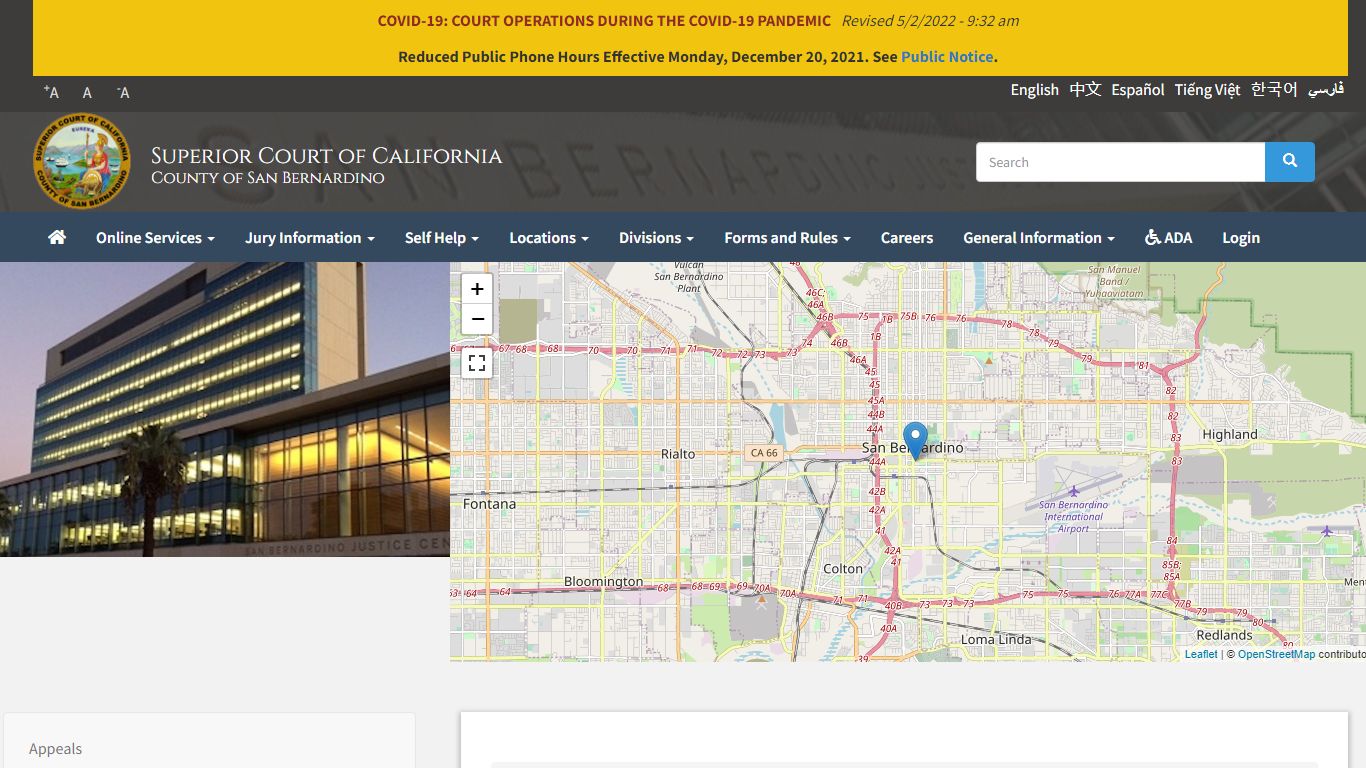
The Criminal Division is located at 247 West Third Street in San Bernardino. This four-story courthouse opened in 1998 and has 12 courtroom suites. It also houses a forensic evidence lab and a victim-services wing. The public counter is open Monday through Friday from 8:00 a.m. to 4:30 p.m. Staff can answer questions about case status, subpoenas, and custody hearings. Call (909) 924-0240 during business hours. All visitors must pass security screenings and show ID for badge verification before entering the trial floor.
Document Access for Attorneys and Researchers
Licensed attorneys, journalists, and researchers can buy scanned documents through the Document Access Portal. The service is called Remote-View® and costs $0.50 per page. Payments are accepted by credit card, ACH, or prepaid voucher. Receipts are automatic. The system tracks downloads to follow California Public Records Act rules. You can request up to 500 pages per order. Delivery takes up to five business days. Since 2020, over 1.2 million pages have been sold. Revenue supports court technology upgrades.
Technology Behind the System
The court uses industrial scanners that capture every page at 600 dpi resolution. This ensures text and signatures are clear. Each file is encrypted with AES-256 before storage. Servers use RAID-10 for redundancy and speed. Data lives in a FedRAMP-approved center with strict access controls. Quality auditors check 5% of each batch for errors. Metadata includes filing date, case type, judge name, and outcome code. All records are indexed in California’s statewide e-filing system. The Railsware platform converts old microfilm files into searchable PDFs. Over 1.8 million legacy records were migrated in 2023.
Recent Case Example
People v. Antonio Jose Aguilar (Case # MSB21008291) was filed on June 25, 2021. The charge was possession of a controlled substance with intent to distribute. Judge Donna Gunnell presided. A preliminary hearing was set for July 15, 2021. The court set a $5,000 bond. As of September 30, 2023, the defense filed a continuance request. The case remains active. This shows how the system tracks updates in real time.
Other Court Locations
The Rancho Cucamonga District serves eastern San Bernardino County. It is at 8303 Haven Avenue, Rancho Cucamonga, CA 91730. The building has three criminal trial rooms and a family-law mediation center. A self-help kiosk prints case-number stickers. The clerk’s office answers calls at (909) 350-9764 from 8:00 a.m. to 12:00 p.m. The public desk has bilingual staff to help non-English speakers. FAQs on the website explain how to request judgments, file motions, or prepare for jury duty. Phone support runs from 9:00 a.m. to 4:00 p.m.
Privacy and Security Rules
The court follows strict privacy protocols. Only authorized users can search by party name. All searches leave no trace on public devices. The “Clear” button resets forms instantly. Scanned files are watermarked to prevent misuse. Access logs track who views sensitive data. Breaches trigger immediate investigations. The system complies with California law on public records and redactions.
Fees and Payment Options
Basic case searches are free. Document sales cost $0.50 per page. Pay online with Visa, Mastercard, or ACH. Prepaid vouchers are available for frequent users. Receipts include transaction IDs for tracking. No cash is accepted online. In-person payments at the courthouse accept cash, check, or card. All fees fund technology improvements and staff training.
Data Availability and Limits
Digitized records start from January 1, 2012. Older files exist on microfilm but are not online. In 2018, the county processed 333,831 new matters. Criminal cases made up 244,098 of them. Data downloads in CSV format include case numbers, charge codes, and disposition dates. Researchers can filter by statute or offense type. The system blocks bulk scraping to protect performance.
Exhibits and Evidence Handling
The Exhibits Department keeps physical and digital evidence safe. Every item gets a barcode linked to the case docket. Photos are taken upon intake. Storage is in climate-controlled vaults. Transfers need two signatures for chain-of-custody. About 4,800 exhibits are processed yearly. These include guns, drugs, phones, and hard drives. Quarterly audits verify all items are accounted for. Only authorized staff can access the vault.
How Judges and Clerks Update Records
Clerks enter new filings daily. Judges approve dispositions before they go live. Updates sync to the portal within minutes. Docket entries show exact times and staff initials. If a mistake is found, a correction form is filed and reviewed. The public sees only finalized, approved data. This prevents confusion from draft or incomplete entries.
Mobile Access and User Experience
The portal works on all devices. Fonts scale for readability. Buttons are large for touch screens. Search fields have auto-suggest for case numbers. Results load quickly even on slow connections. Users can download PDFs or print directly. No app is needed—just a browser. The design follows state accessibility standards for screen readers.
Common Errors and How to Fix Them
If a case doesn’t appear, check the spelling of names or numbers. Use the wildcard (*) after two letters for partial matches. Make sure you’re logged in for party searches. If the system is slow, try again later—peak hours are 9–11 a.m. For missing documents, contact the clerk at (909) 924-0240. Provide the case number and filing date. Staff can re-scan or re-index if needed.
Legal Rights and What to Expect
Defendants have the right to see their own records for free. They can request corrections if info is wrong. Victims may ask for redactions of personal details. Attorneys get faster access with bar numbers. Self-represented litigants can use the self-help kiosk. All users must follow court rules against misuse of data.
Contact Information
Main Courthouse: 247 West Third Street, San Bernardino, CA 92415 Phone: (909) 924-0240 Hours: Monday–Friday, 8:00 a.m.–4:30 p.m. Website: https://www.sb-court.org Document Sales Portal: https://www.sb-court.org/divisions/civil-general-information/court-case-information-and-document-sales
Frequently Asked Questions
People often ask how to find old cases, correct errors, or get certified copies. Below are detailed answers based on current court policies and user needs.
Can I search for cases before 2012?
Cases before January 1, 2012, are not digitized and cannot be searched online. They exist on microfilm at the courthouse. To view them, visit the public counter at 247 West Third Street or call (909) 924-0240 to schedule an appointment. Staff will retrieve the film and help you review it. There is no fee for viewing, but copies cost $0.50 per page. The process may take one to three business days depending on volume. Bring a valid ID and the case number if known. If you don’t have the number, provide the defendant’s full name and approximate year. This ensures staff can locate the correct file quickly.
Why can’t I search by name without logging in?
Party-name searches require login to protect privacy. California law limits public access to personal identifiers unless the user has a legitimate reason. Logging in verifies your identity and tracks usage. Once authenticated, you can search using the first two letters of a last name plus an asterisk (e.g., “Sm*”). This returns all matching records without exposing full names to the public. The system does not save your search history. Always use the “Clear” button after searching to reset the form. If you’re a journalist or researcher, apply for access through the Document Access Portal. Approved users get extended search rights.
How do I get a certified copy of a court document?
Certified copies must be requested in person or by mail. Online downloads are not certified. Visit the clerk’s office at 247 West Third Street with your ID and case number. Staff will print and stamp the document with an official seal. The fee is $0.50 per page plus a $15 certification charge per document. Processing takes 15–30 minutes during business hours. For mail requests, send a written request, payment, and a self-addressed stamped envelope to the same address. Include a phone number in case of questions. Certified copies are valid for legal proceedings, background checks, and government forms.
What if I find incorrect information in a case record?
If you spot an error, contact the clerk immediately at (909) 924-0240. Provide the case number, incorrect detail, and correct information. The court will review and file a correction if warranted. Minor typos may be fixed quickly. Major changes, like charge amendments, require judicial approval. You’ll receive a confirmation once updated. The online portal reflects corrections within 24 hours. Keep a copy of your communication for your records. Do not attempt to edit the record yourself—only court staff can make official changes.
Are traffic tickets included in the criminal case search?
Yes, traffic violations are part of the criminal case database. Search by citation number (e.g., “2022-004567”) to find tickets for speeding, red-light violations, or equipment issues. Results show fine amounts, due dates, and court appearances. Payments can be made online through the court’s payment portal. Failure to pay or appear may result in a hold on your license or a warrant. Traffic cases are misdemeanors unless they involve injury or DUI. Check the outcome code to see if the ticket was dismissed, paid, or contested.
Can I use this system for background checks?
The portal provides public docket information but is not a full background check service. It shows active and resolved criminal cases in San Bernardino County only. For employment or licensing, you may need a state-level check from the California DOJ. The court data is accurate as of the last update but does not include sealed or expunged records. Always verify with official sources. Researchers and employers should combine this data with other databases for completeness.
How often is the case information updated?
The system updates in real time from the clerk’s office. New filings, rulings, and continuances appear within minutes. Judges and staff enter data daily. Weekends and holidays cause minor delays. The portal displays a timestamp on each docket entry. If you don’t see a recent change, refresh the page or wait an hour. For urgent matters, call the clerk to confirm status. Real-time updates ensure users get the most current information available.